
The Shaman Parmenides
On Recognizing Parmenides As More Mystic Than Philosopher

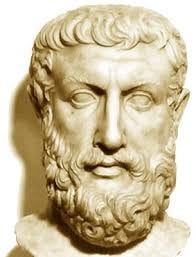
Peter Kingsley’s restoration of Parmenides’s shamanic and Eastern spiritual roots uproots more than two millennia of misunderstanding, beginning with Plato, and epitomized by Aristotle’s characterization of Parmenides’s argument as “merely contentious” philosophy, whose “premise” was “false” and whose “conclusions” did “not follow.” Although Plato called Parmenides “Father” and reserved the assessment “deep” (bathos) exclusively for him, Plato’s abstract, immutable essences or Forms, derived from rational philosophic analysis, are a shallow follow-up to Father’s shamanic insight that the entire universe is ultimately One and immutable.
This deepest of ancient insights, as in the Bhavaga Gita:
“Of the impermanent one finds no being;
One finds no non-being of the permanent.
Indeed, the certainty of both of these has been perceived by seers of the truth”
is no longer merely ancient. Parmenides, after all, was Karl Popper’s unresisted nickname for Einstein, a fellow eternalist by a different route. Einstein’s breakthrough insight, that led him to believe the separation between past, present, and future was “an illusion, however stuborn,” came from his contemplating the nature of light. Parmenides’ breakthrough insight, that led him to believe “Nor was it ever, nor will it be, since now it is, altogether one, continuous” may well have come to him in the dark.
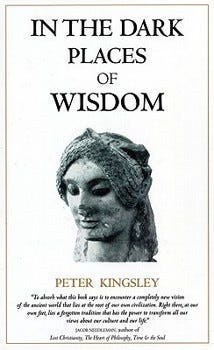
As we now know, via Peter Kingsley’s research, Parmenides was an Iatromantis, a healing priest of Apollo, as well as a Pholarchos, or “cave leader,” who supervised both sleep and wake-entranced “incubations” called “Apollo’s Ecstasy”. These Ecstasies induced healing guidances and prophetic visions. Think of (though Kingsley doesn’t) Edgar Cayce, “the sleeping prophet,” known not only for his trance-induced healing remedies but his precognitions. It is, at any rate, this same eternalistic overcoming of Einstein’s “stubborn illusion” that Kingsley highlights about “Apollo’s ecstasy” which
“…happened in such stillness that anyone else might hardly notice it or could easily mistake it for something else. But in this total stillness there was total freedom…from space and time….It’s stillness that has the power to carry a human being into another reality: into a world of prophecy where future and past and present are all contained.”
Such revelations from this mystical sourcing are more aligned with Eastern Monism than one might expect from the Western “father of logic and metaphysics.” But as Kingsley further establishes, Parmenides had links with Indian thought through the extensive trading and migrating of the Phocaean Greeks. Based in Western Turkey—with significant contact with Persian traders who in turn had significant contact with Indian traders—Phocaens founded Parmenides’s hometown of Elea (in southern Italy).
It is, however, worth noting that Parmenides’s thematic connections to Indian thought had been commented on by other Greek scholars before Kingsley.
To begin with, William James’s beloved friend and polyglot scholar, Thomas Davidson, in his 1869 book on Parmenides, noted that Parmenides’s verse “bears a striking resemblance to one of the hymns in the tenth book of the Rig-Veda,” and then quotes the seminal text:
“Nor aught nor naught existed; yon bright sky
Was not, nor heaven’s broad roof outstretched above.
What covered all? what sheltered? what concealed?
Was it the water’s fathomless abyss?
There was not death — hence was there naught immortal,
There was no confine betwixt day and night;
The only One breathed breathless in itself,
Other than it there nothing since has been.
Darkness there was, and all at first was veiled
In gloom profound — an ocean without light.
The germ that still lay covered in the husk
Burst forth, one nature, from the fervent heat.
Then first came Love upon it, the new spring
Of mind/ yea, poets in their hearts discerned,
Pondering, this bond between created things
And uncreated. Comes this spark from earth,
Piercing and all-pervading, or from heaven?
Then seeds were sown and mighty power arose —
Nature below, and Power and Will above.
Who knows the secret? Who proclaimed it here,
Whence, whence this manifold creation sprang? —
The gods themselves came later into being. —
Who knows from whence this great creation sprang? —
He from whom all this great creation came,
Whether his will created or was mute,
The Most High Seer that is in highest heaven,
He knows it — or, perchance, e’en he knows not.”
German Sanskritist Richard Garbe was another scholar noting the link. In an 1893 Address entitled “On The Connexion between Indian and Greek Philosophy,” delivered before the Philological Congress of the World’s Fair Auxiliary at Chicago and published the following year in the philosophy journal The Monist, he observed, “The coincidences between Indian and Greek philosophy are so numerous that some of them were noticed immediately after the Indian systems became known to Europeans.” He then elaborated:
“The most striking resemblance — I am almost tempted to say sameness — is that between the doctrine of the All-One in the Upanishads and the philosophy of the Eleatics. . . . Parmenides holds that reality is due alone to this universal being, neither created nor to be destroyed, and omnipresent; further, that everything which exists in multiplicity and is subject to mutability is not real; that thinking and being are identical. All these doctrines are congruent with the chief contents of the Upanishads and of the Vedanta system, founded upon the latter. Quite remarkable, too, in Parmenides and in the Upanishads, is the agreement in style of presentation; in both we find a lofty, forceful, graphical mode of expression, and the employment of verse to this end . . . I therefore do not consider it an anachronism to trace the philosophy of the Eleatics to India.”
More recently, but 2 decades before Kingsley’s compelling case for Parmenides as more Eastern-style mystic than Western-style logician, German scholar Oscar Marcel Hinze had done the same. In his 1979 book, Tantra Vidya,
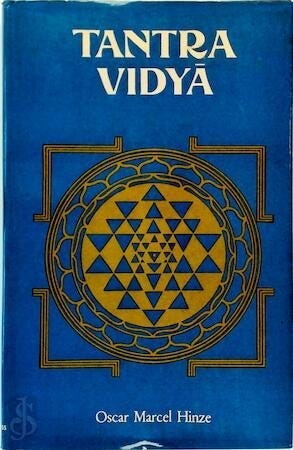
Hinze wrote that Parmenides’s text
“exhibits numerous characteristic features, which also characterize the Indian Yoga. I even believe that this . . . poem represents, in this respect, a unique phenomenon in world literature: neither in old literature nor in new, have I met a text which shows in so concise a space such a great number of facts from the sphere of yoga-philosophy in a proper right context.”
However much, though, Parmenides may have been influenced by Eastern spirituality, it is worth noting that Parmenides’s own direct mystical experience, as with Plotinus’s, was his ultimate touchstone. And Kingsley, in his astonishing book Reality,
is our peerless guide to Parmenides’s (as well as Empedocles’s) elucidation of that experience.
[Expanded excerpt from The Illusion of Will, Self, and Time: William James’s Reluctant Guide to Enlightenment ]